- Breadboards are the basic building blocks of designs circuits. The two outer parts have two columns each, one negative(black) and the other positive(red). The inner part is a grid that carries current in rows left to right, but not up and down, or across the middle of the breadboard. Breadboards are used to design circuits before you actually manufacture them, as they are easily modifiable if something is wrong.
2. This is my video of the circuit working
https://www.youtube.com/watch?v=s_9OI1fWiak&feature=youtu.be
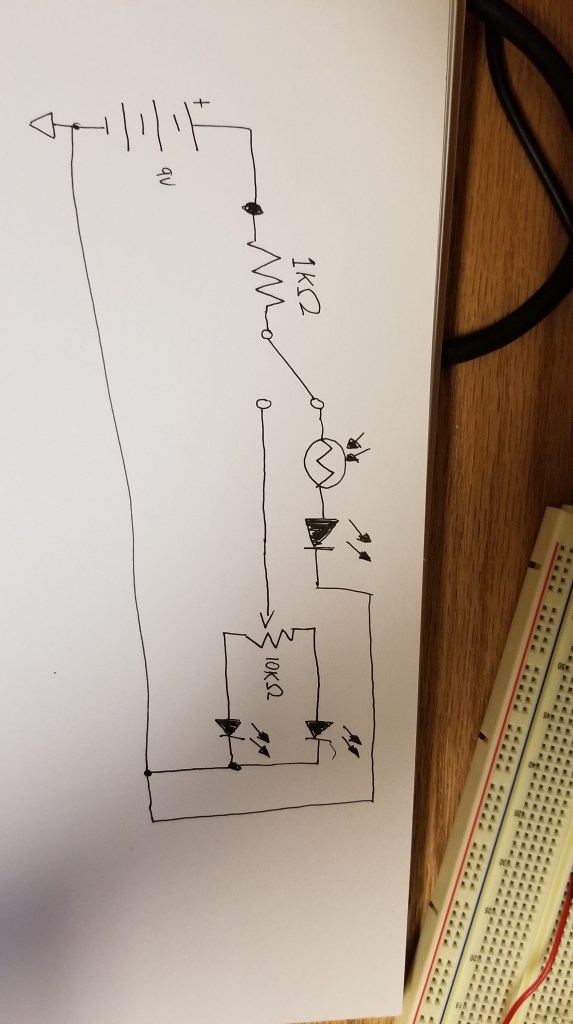
And this is a diagram of that circuit
3. Multimeters determine the voltage and resistance of a circuit. They are very useful in determining where in a circuit you may be encountering issues, by touching the ends of the multimeter to various parts of the circuit.
4. https://connoranaloglab.music.blog/2020/02/02/analog-circuit-troublshooting-notes/
5. Shane Paterson’s Saturizer is a really cool final project. It has a really nice sound and seems relatively easy to make. The diode clipping sounds great, and I’d love to maybe put together a version of this in my own time.
Jaye Sosa’s polyphonic synth is another really great sounding project, especially the fact that it seems to have the ability to be programmed in some interesting ways. I’m looking forward to knowing exactly how to build a synthesizer later in the class with the knowledge I’ll gain.
Connor Riley’s multi-effects processor is incredibly impressive, all the effects sound great and in just one breadboard I have no clue how he made it work so well. This is a pedal I would absolutely buy.
 Connor's Analog Lab Blog